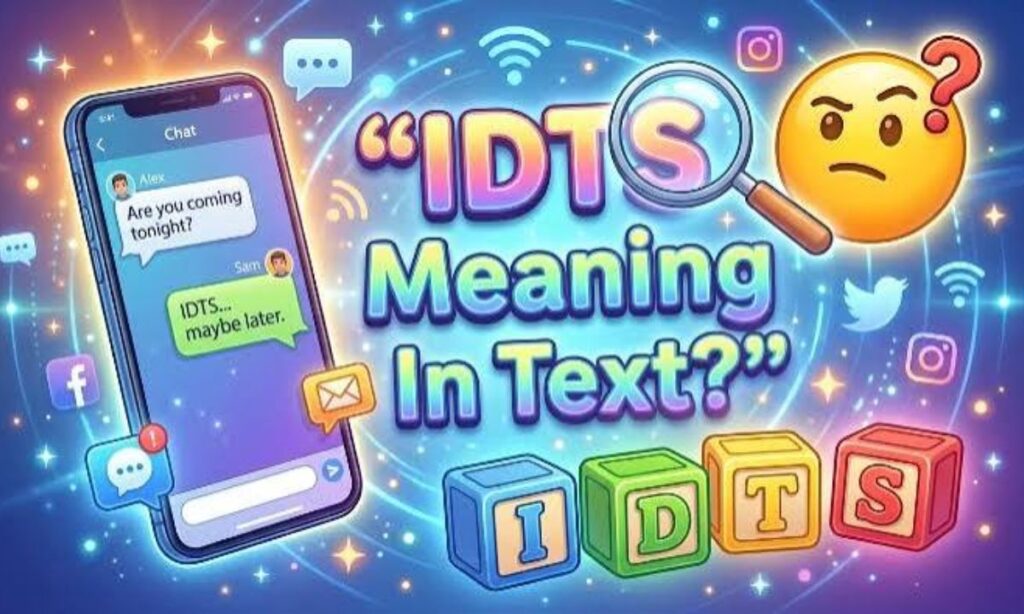
Texting slang changes fast, and IDTS is one term you might see often in 2026. It stands for “I don’t think so.” People use it to disagree quickly in chats, comments, and messages. If you saw it and felt confused, this guide will clear it up.
This article explains the full meaning of IDTS in simple words. You will learn how to use it correctly and when to avoid it. We also cover real examples from Snapchat, TikTok, and everyday texting. By the end, you will understand IDTS completely and use it with confidence.
What Does IDTS Mean In Text?
IDTS stands for “I Don’t Think So.” People use it to disagree with something in a short and casual way. It is one of the many texting abbreviations that save time while chatting. This term shows up in casual chats, group messages, and social media comments. It works as a quick way to say no or to express doubt without typing a full sentence.
Most Common IDTS Meaning In Text
The most common meaning of IDTS is simple disagreement. Someone says something, and the other person replies with IDTS to show they do not agree or do not believe it.
Example: Friend: “It’s going to rain today.” You: “IDTS, the sky looks clear.”
Common IDTS Meaning
In most chats, IDTS means a soft way of saying no. It is less harsh than typing “no” directly. People use it to keep the tone light and friendly.
Less Common IDTS Meaning
Sometimes IDTS is used to express uncertainty rather than full disagreement. It can mean “I am not sure that is true” instead of a hard no.
Rare IDTS Meaning
In rare cases, some people use IDTS as a joke or sarcastic reply, even when they actually agree. This usage depends heavily on tone and relationship between the texters.
Origin And Evolution Of IDTS
Texting slang grew fast with the rise of SMS and early messaging apps. People wanted shorter ways to type common phrases. IDTS became one of many abbreviations like IDK, TBH, and NGL.
As smartphones and social apps grew, IDTS moved from basic texting into comment sections, direct messages, and gaming chats. Its short and easy structure made it popular across different platforms.
Over time, the phrase kept its core meaning but adapted slightly based on tone, punctuation, and context. Today it appears in casual talk, memes, and even business chats in a lighter form.
Psychological And Emotional Meaning Of IDTS
IDTS often reflects a person’s inner doubt or hesitation. It shows they are processing information and choosing not to accept it fully. This makes it a mild and non aggressive way to disagree.
People use IDTS to protect the flow of conversation. Instead of creating conflict, they express doubt while keeping things smooth. It softens disagreement compared to blunt words like “wrong” or “no way.”
Communication Function Of IDTS
IDTS functions as a quick disagreement tool in daily chats. It helps conversations move faster without long explanations. It also gives the sender a chance to challenge an idea politely.
This short form works well in fast paced texting environments where speed matters more than detailed grammar. It fits naturally into casual writing styles used by teens and young adults.
Cultural And Generational Context Of IDTS
Younger generations, especially Gen Z, use IDTS often in daily texting. It fits their preference for short, quick, and casual language. Older generations may use it less, but many now understand and use it too because texting slang spreads fast through social media.
IDTS is common in English speaking countries, but similar short disagreement phrases exist in many languages and texting cultures worldwide.
Why IDTS Became Popular
IDTS became popular because it is short, clear, and easy to type. In fast texting, saving even a few seconds matters. It also fits perfectly into informal digital communication where full sentences feel too formal.
Its rise connects with the general trend of texting abbreviations like LOL, BRB, and OMG. People enjoy shortcuts that keep chats light and fun.
Semantic Core Meaning Of IDTS
At its core, IDTS always relates to doubt or disagreement. Whether used seriously or jokingly, the base meaning stays connected to not fully accepting a statement.
Most Common IDTS Meaning In Text
What It Means
IDTS mainly means “I don’t think so.” It expresses disagreement, doubt, or a polite refusal. This meaning stays consistent across most texting platforms.
Typical Use Cases
People commonly use IDTS in these situations:
• Disagreeing with an opinion • Rejecting a plan or suggestion • Expressing doubt about facts • Responding to rumors or gossip • Reacting to predictions
Examples In Different Tones
Casual tone: “Wanna go out in this heat?” “IDTS lol”
Serious tone: “He said the meeting got cancelled.” “IDTS, I just saw the invite.”
Sarcastic tone: “Yeah sure, pigs can fly too.” “IDTS 😂”
What It Can Sound Like
IDTS can sound casual, doubtful, sarcastic, or even slightly dismissive depending on punctuation and emojis. Adding “lol” or a laughing emoji softens it. Adding a period or no emoji can make it sound more serious.
Variations And Forms Of IDTS
Here are common variations people use:
| Variation | Meaning |
| idts | I don’t think so |
| Idts. | Serious disagreement |
| idtsss | Playful or exaggerated disagreement |
| IDTS? | Uncertain disagreement, asking for clarity |
IDTS Vs Similar Slang
| Term | Meaning |
| IDTS | I don’t think so |
| IDK | I don’t know |
| IMO | In my opinion |
| NGL | Not gonna lie |
| TBH | To be honest |
IDTS focuses on disagreement, while IDK shows lack of knowledge. IMO and TBH express personal opinion rather than direct doubt.
Meaning Based On Context
Positive Use
Sometimes IDTS softly challenges an idea in a friendly way, like joking about weekend plans.
Neutral Use
Often it simply expresses a mild doubt without any strong emotion attached.
Negative Or Critical Use
In some chats, especially heated ones, IDTS can carry a firm or blunt tone showing clear disagreement.
Dry Or Rushed Use
People also type IDTS quickly without much thought, just as a fast reaction during busy conversations.
IDTS Meaning Medical
In medical or health related chats, IDTS still means “I don’t think so” and is used casually between friends discussing symptoms. It is never used as an official medical term or diagnosis. People simply use it to express doubt about a health claim or rumor.
IDTS Meaning In Business
In workplace chats, IDTS is used carefully and mostly in casual internal messages between coworkers. It works as a polite way to disagree, such as questioning a deadline or plan. It is best avoided in formal emails or client communication.
How IDTS Is Used In Real Conversations
Understanding Or Clarifying
People use IDTS while trying to clarify facts, such as correcting rumors or wrong assumptions in a group chat.
Reacting Or Labeling
IDTS also works as a quick reaction label, similar to a thumbs down emoji but in text form.
Social Or Dating Context
In dating chats, IDTS might show doubt about compatibility or plans, like “IDTS we should rush into this.”
Group Or Online Context
In group chats, IDTS often appears when multiple people disagree with one idea at once.
Gaming Context
Gamers use IDTS during matches to disagree with strategies, like “IDTS we should push now.”
IDTS Meaning On Different Platforms
IDTS Meaning On Snapchat
On Snapchat, IDTS is used in quick chat replies, often paired with emojis to show tone clearly.
IDTS Meaning On TikTok
On TikTok, IDTS frequently appears in comment sections, disagreeing with opinions in videos.
IDTS Meaning On Instagram
On Instagram, people use IDTS in DMs and comments to react to posts or stories.
IDTS Meaning In Texting Or Messaging
In regular SMS or messaging apps, IDTS keeps its core meaning as a short and casual disagreement.
IDTS Meaning On Discord Or Communities
In Discord servers, IDTS is common during debates or group discussions, especially in gaming or fandom communities.
Idrt Meaning Text
IDRT usually stands for “I don’t really think” and works as a softer cousin of IDTS. People use it when they want to disagree but leave room for doubt in their own opinion. It often appears in casual chats where the sender is not fully certain either way.
Idtg Meaning In Chat
IDTG can mean “I don’t think so” or “I don’t get it” depending on the conversation. The correct meaning depends on whether the reply follows a statement or a confusing message. Readers should check the context before assuming which meaning fits.
When To Use Vs When To Avoid IDTS
When To Use
• In casual friendly chats • When disagreeing lightly • During informal group discussions • In gaming or social media comments
When To Avoid
• In formal emails • During serious professional conversations • When discussing sensitive topics • In official documents or reports
Professional And Safe Alternatives
Here are safer alternatives for formal settings:
| Casual Term | Professional Alternative |
| IDTS | I don’t believe that is accurate |
| IDTS | I have some doubts about this |
| IDTS | I am not fully convinced |
Hidden Or Risky Meanings Of IDTS
In some rare and specific slang circles, letters can carry different or inappropriate meanings depending on group context. It is always smart to check the full conversation and tone before assuming its meaning, especially with unfamiliar contacts online.
How To Decode The Correct Meaning
To understand IDTS correctly, always check:
• The topic of conversation • Emojis or punctuation used • Relationship with the sender • Overall tone of the chat
How To Respond To IDTS
Casual Replies
“Haha fair enough.” “Okay maybe you’re right.”
Friendly Replies
“Lol why not though?” “Tell me why you think that.”
Mature Or Respectful Replies
“That’s okay, we can agree to disagree.” “I understand your point.”
Boundary Or Privacy Responses
“No worries, let’s drop it.” “That’s fine, we don’t have to discuss further.”
Common Misunderstandings About IDTS
Many people confuse IDTS with IDK or IDC. Some also assume it always means strong disagreement, when it can simply express mild doubt. Tone always matters more than the letters themselves.
Regional And Cultural Usage Of IDTS
IDTS is mostly popular in English speaking regions like the US, UK, Canada, and Australia. However, due to global social media use, it now appears in texting culture across many other countries too, especially among younger internet users.
Frequently Asked Questions
What does IDTS mean in a text message?
IDTS means “I don’t think so.” People use it to disagree or express doubt quickly in a text.
Is IDTS rude to use?
No, IDTS is not rude. It is a casual and mild way to disagree, especially among friends.
Can IDTS mean something else?
Yes, in rare cases IDTS can be sarcastic or used differently based on tone and context.
Is IDTS the same as IDK?
No, IDTS means “I don’t think so,” while IDK means “I don’t know.” They express different ideas.
Where is IDTS most commonly used?
IDTS is common on Snapchat, TikTok, Instagram, Discord, and regular text messaging.
Should I use IDTS in professional chats?
It is better to avoid IDTS in professional chats and use full polite sentences instead.
How do I reply to IDTS in a chat?
You can reply casually by explaining your reasoning or simply accepting the disagreement politely.
Final Thoughts
IDTS is a simple and popular texting term that means “I don’t think so.” It helps people disagree quickly without sounding harsh. Understanding its meaning makes texting smoother, especially with friends, on social media, and in casual group chats.
As texting slang keeps evolving every year, knowing terms like IDTS helps you stay updated and communicate clearly across different platforms. Whether you use it casually or come across it in a chat, you now have a complete understanding of what IDTS truly means and how to use it the right way.